

A Carefully Selected Selection of XLR Microphone Cables! A Detailed Explanation of How to Choose Them and the Differences in Sound Quality
XLR cables are essential for connecting audio equipment such as microphones, mixers, and audio interfaces. Used not only in professional settings but also for home streaming and recording, these cables are crucial for sound quality.
However, many people may wonder, "Which one should I choose?" or "Are expensive cables really better quality?"
This article thoroughly explains everything from the correct way to choose an XLR microphone cable to the differences in sound quality due to cables, and carefully selected recommended models. Let's find the perfect cable for your needs!
XLR Cable Basics: Balanced Connection is Key for Microphone Cables!
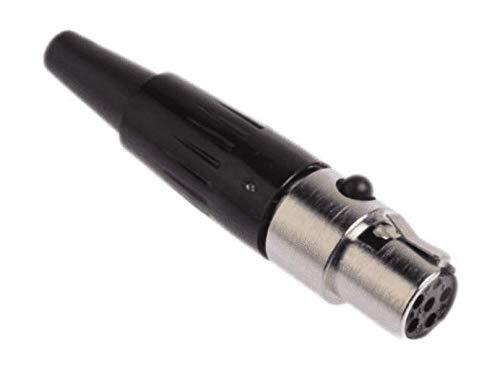
XLR cables are primarily used for transmitting microphone and line-level signals, characterized by their circular, 3-pin connectors.

High Noise Immunity with Balanced Connection
The main feature of XLR cables is their "balanced connection."
Unlike typical shielded (unbalanced) cables, they consist of two signal wires (positive and negative phase) and a shield wire (GND) to protect against noise, totaling three conductors.
This mechanism cancels out noise generated within the cable, maintaining a clear sound quality with high noise immunity and less degradation, even over long distances. This is why XLR cables are standard in professional settings.
How to Choose the Right XLR Microphone Cable
Here are the four important points to check when choosing an XLR cable:
Point 1: Cable "Length"
Home recording/streaming: 1.5m to 3m
Easy to manage and minimizes noise impact.
Studio/Live: 3m to 10m
Consider the distance between connected devices. Making it longer than necessary increases the risk of noise.
It is generally best to choose the minimum necessary cable length. Longer cables are more susceptible to picking up noise, which can lead to sound quality degradation.
Point 2: Sound Quality Differences by Conductor (Material)
The sound quality of a cable is greatly affected by the material of its conductors, which transmit the signal.
OFC (Oxygen-Free Copper) is especially recommended for its ability to produce clear sound with good cost performance.
Point 3: Cable Structure (Number of Cores)
2-core cable: Common. Standard microphone cable. Standard.
4-core cable: Uses two sets of conductors (4 cores total). Has higher noise immunity and better durability than 2-core cables.
If your budget allows, choosing a 4-core cable (e.g., MOGAMI 2534) can achieve even more stable and high-quality sound with better noise immunity.
[Carefully Selected] Recommended XLR Microphone Cables
Here are our top recommended XLR microphone cables.
MOGAMI 2534 XLR Microphone Cable NEUTRIK Gold Plated

■OFC (Oxygen-Free Copper)
Recommended for: Its neutral characteristics make it suitable for all genres.
Price: From ¥3,520
Go to Product Page>>

Well-balanced from high to low frequencies, with particularly good high-frequency extension for clear and sharp sound.
■OFC (Oxygen-Free Copper)
Recommended for: Its high-quality design makes it ideal for recording, especially microphone recording.
Price: From ¥3,520
Go to Product Page>>
CANARE L-4E6S XLR Microphone Cable

Features: Neutral tone without emphasizing specific frequency ranges, suitable as a reference. Features a stranded structure using very fine wires, making it resistant to kinking, robust, and easy to handle.
■4-core
Recommended for: Widely used in professional settings such as stages, studios, and for broadcasting/news coverage.
Price: From ¥3,320
Go to Product Page>>
ONKODO 88760 XLR Microphone Cable

Recommended genres: Rated as a perfect and neutral cable suitable for all music genres, its monitor-like flat characteristics and clear sound quality make it highly regarded for professional environments requiring precise sound quality, such as recording and sound adjustment, and for pure audio applications.
Price: From ¥3,790
Go to Product Page>>
Summary
XLR microphone cables don't just connect sound; they play a crucial role in clearly transmitting your performance.
First, choose the appropriate length, and we recommend starting with classic models like CANARE. Later, if you want to further pursue sound quality, step up to high-grade models with OFC or 4-core construction.
Also,
If you're interested in how to choose a microphone cable specifically for female vocal streamers,
please also refer to the article below.
▶ [For Female Vocal Streaming]How to Choose a Microphone Cable that Brings Out Clarity

Find the perfect cable and get clearer, richer sound! ✨
>> All Onkodo XLR Microphone Cables Here